
Why Choosing the Right Ramp Matters
Choosing the right ramp for your property is about more than simply providing access, it’s about safety, practicality, and compliance. Whether for a home, office, or public building, the right ramp ensures users can move confidently and independently.
From understanding who will use it, to considering height, gradient, and available space, every property has unique requirements. This guide will help you understand the key factors involved in selecting a ramp that is safe, functional, and suited to your needs, while highlighting how professional support can make the process easier.
Who Will Be Using the Ramp?
One of the most important considerations when choosing a ramp is understanding who it is being designed for, as this will quickly narrow down the most suitable options.
For residential properties, this process is often more straightforward. There are typically fewer regulatory considerations, and the ramp is usually designed around one primary user. However, it’s still important to think about the type of mobility equipment being used, whether access will be independent or assisted, and how the user’s needs may change over time.
In public and commercial settings, the requirements are more complex. Higher footfall means the ramp must safely accommodate a wider range of users, including wheelchair users, mobility scooters, walking aids, prams, and delivery trolleys. Because users will often be accessing the ramp independently, it must be intuitive, safe, and suitable for continuous use.
By identifying who will be using the ramp from the outset, it becomes much easier to design a solution that is practical, inclusive, and appropriate for the environment.
Understanding Height, Gradient and Space
When designing a ramp, government guidelines determine how steep it can be. These guidelines take into account:
- Height to overcome
- Ramp length
- Available installation space
Ramp gradient is a key factor for safety and confidence. Steeper ramps reduce control, which can be risky for anyone with mobility challenges, especially in busy environments.
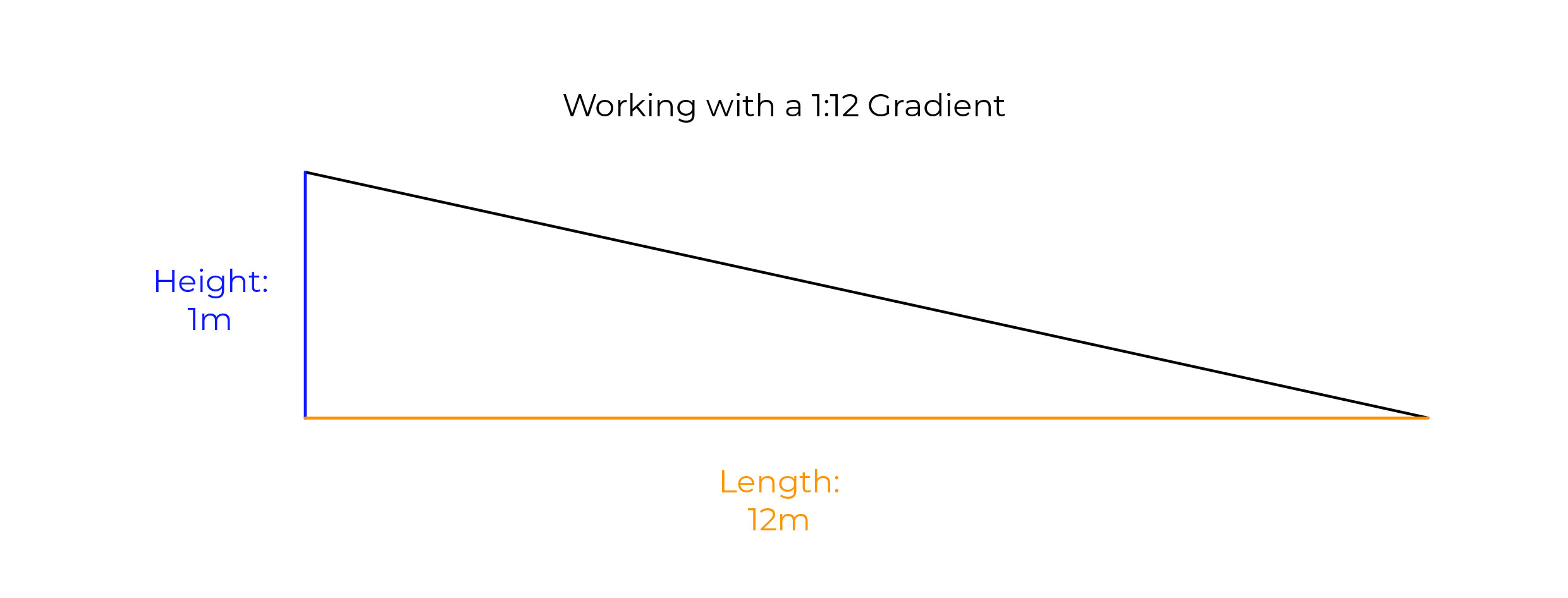
You may see gradients written as 1:12. This means for every 1 unit of vertical rise, the ramp must extend 12 units horizontally. For example, a 1-metre rise requires a 12-metre ramp length. There are many different government compliant gradients which are useful for different scenarios. Take a look at how this applies to different settings:
- 🏠 Residential: A general understanding of height and space is usually enough. Many homeowners choose a professional assessment to ensure the ramp is safe and practical without unnecessary hassle.
- 🏢 Public & Commercial: Precise measurements are essential. Higher footfall and independent use mean that gradients, landings, and layout must be carefully planned to meet safety and accessibility standards.
To ensure your ramp is compliant, you can refer to Approved Document K, or take advantage of our FREE surveyor assessment, where we visit your property, take accurate measurements, and recommend a solution tailored to your space.
Understanding the Different Types of Ramps
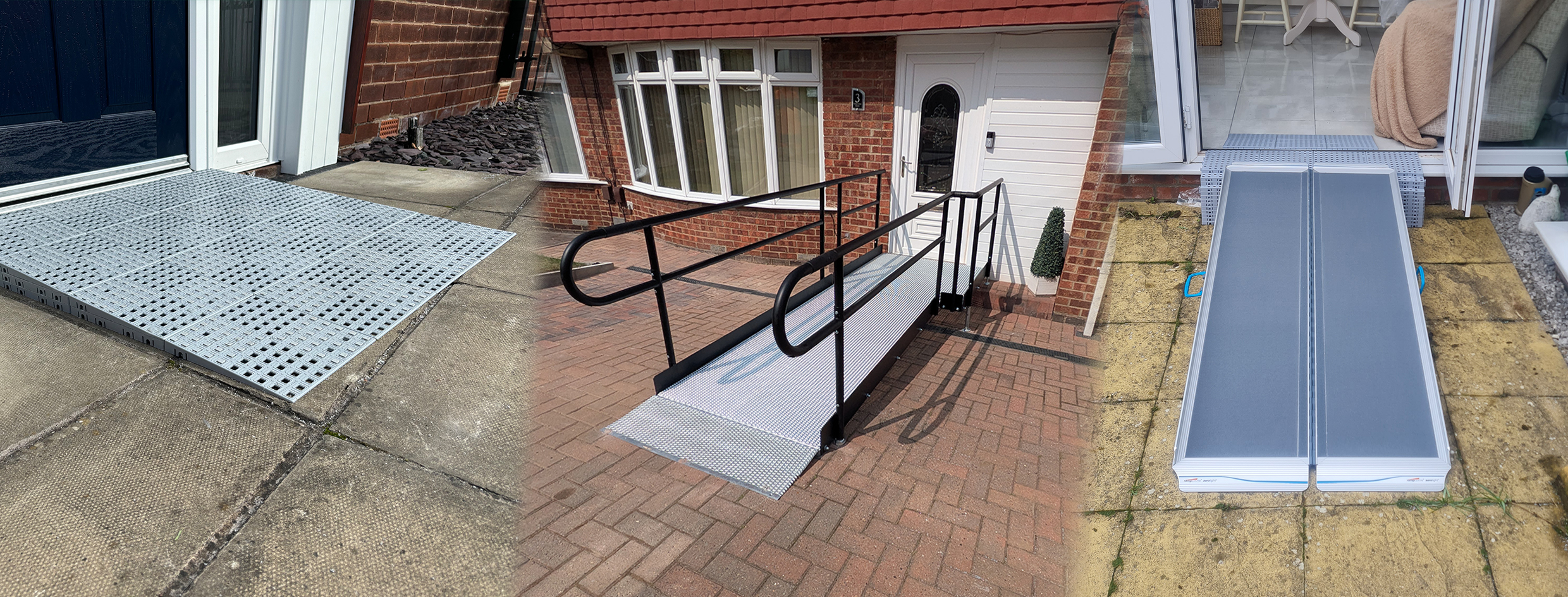
Choosing the right ramp isn’t always straightforward, there are several different types, each suited to specific needs and environments. The main options are threshold ramps, modular ramps, and portable ramps. Each type has its own advantages depending on the height, space, and user requirements.
Threshold Ramps
Threshold ramps are ideal for small inclines, such as doorways or single steps. They are easy to install and remove, making them a semi-permanent solution. At Easiaccess, we use the Excellent Systems Range, which offers durable, safe threshold ramps suitable for both residential and light commercial use.
Modular Ramps
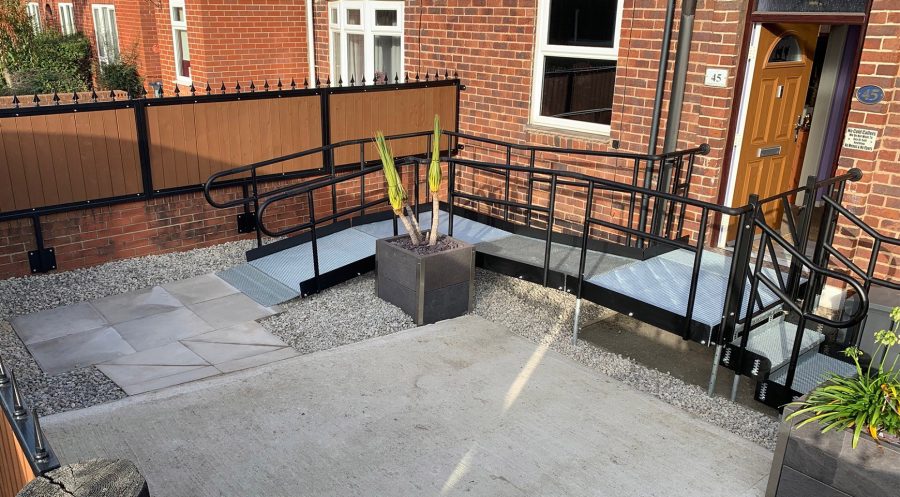
Modular ramps are highly flexible and customisable, making them suitable for both residential and commercial properties. They can be designed to fit almost any space and accommodate any height. Modular ramps can also include custom surfaces, edge indicators like yellow nosing, and other features tailored to the user’s mobility needs. Because of this versatility, modular ramps are our most popular solution.
Portable Ramps
Portable ramps are lightweight and temporary, designed for use on the go. They are perfect for overcoming obstacles like steps, kerbs, or doorways, whether at home or in public spaces. Portable ramps are ideal when flexibility or short-term access solutions are needed.
Safety Features Compliance Considerations
Safety is the most important factor when choosing a ramp, even more so in a public setting where you may be held accountable for the solution. Key features help users move confidently and independently:
- Handrails & Edge Protection: Provide stability and prevent slips. Essential for public ramps and helpful at home.
- Anti-Slip Surfaces: Reduce the risk of accidents, especially outdoors or in wet conditions.
- Level Landings: Allow users to rest, turn, or safely enter and exit. Required for longer or steeper ramps.
- Width & Accessibility: Must accommodate the user and mobility device. Wider ramps are vital for public spaces.
There are still more rules and regulations that you should be following for some of these features, but all this can be found in the Approved Document K. At Easiaccess, we design ramps to be safe, practical, and compliant for all users.
Temporary vs Permanent Solution
Another consideration you should be thinking about is how long you want this ramp there for. Is this going to be a long-term solution that will be used frequently or is it something that is going to be used every so often so doesn’t need to be permanent.
Temporary
These are for short term use where they would be ideal to move the ramp when not in use. This is where you are more likely to use a threshold or portable ramp, so you still get the accessibility, but only when you need it.
Permanent
These are for long term solutions where you may need accessibility on a constant basis. At home this may be down to the user’s mobility challenges where they may need access to a ramp permanently. For a public setting you may need to give access to anyone with mobility challenges at any time, and choosing a temporary option may not be a suitable.
Easiaccess’ Semi Permanent Solution
Our most popular product, the metal modular ramp, can be classed as a semi permanent solution. This means that it can be installed for long term use and stay there as long as you need it, however if it needs to be removed or taken away at any point, it can easily be done.
Where Do We Come In?
If all this information feels overwhelming, you don’t need to worry – that’s what we’re here for. With over 25 years of experience in specialist adaptations, we know exactly what’s needed to create a safe, compliant, and practical ramp.
Our team can visit your property and carry out a FREE survey, taking all the measurements and planning the perfect solution for your space. This means you get a ramp tailored to your needs, without any hassle or guesswork.
Conclusion
Selecting the right ramp is a crucial step in creating accessible, safe, and practical spaces. By considering who will use the ramp, the gradient, space constraints, type of ramp, safety features, and whether a temporary or permanent solution is best, you can ensure your ramp meets both your needs and regulatory requirements.
For both residential and public settings, professional guidance can remove the guesswork and guarantee a solution that is tailored, safe, and compliant. At Easiaccess, we help you make the right choice without any hassle, giving you confidence that your ramp is perfectly suited to your property and users.
Contact
Request a free survey and quote or discuss what product and service is best for you.
Make Enquiry